30-day risk-freeShopShop the TechRing

FirmTech Labs & Health Coaching

Your biomarkers. Your nights. Your firmest, fittest self.

A complete men's health panel you run at home. We read your bloodwork alongside your nightly data and give you clear guidance for a longer, stronger life.

About the coaching
  • Collected at home
  • No clinic visit
  • Complimentary coaching call included

TechRingExclusive to owners of the TechRing. Ongoing coaching built around your own data, so every change you make shows up in your results.

Two halves of one picture

Your biomarkers are a snapshot.
Your nights are a trend.

Most men get one of these, at best, and almost never together. Read side by side, they answer a question neither one answers alone: is what your biomarkers show actually turning up in how your body performs?

18 biomarkers

  • Hormones 7
  • Cardiovascular 6
  • Kidney 3
  • Liver 2

FirmTech Labs

What your biomarkers show

Most men have never had their testosterone measured. Fewer still have seen the markers that sit around it, and a standard annual physical rarely asks.

Eighteen biomarkers, weighted toward hormones and cardiovascular risk, across hormones, cardiovascular and lipid markers, kidney function and liver function. A panel built for men's health rather than a general wellness panel with testosterone bolted on.

One panel, one purchase, collected at home. The kit ships as soon as you order and your sample goes back by mail, so there is no clinic and no waiting room. Your complimentary coaching call is included.

See all 18 biomarkers and what they mean

Every night

  • Firmness
  • Duration
  • Nightly erections

The TechRing

What your erections show

Worn during sex, the TechRing measures firmness and duration. Worn overnight, it counts the erections a man sleeps through and never sees.

Those nightly numbers are the trend line. A single night says little; eight weeks of nights say a great deal, and they are the half of the picture no panel can reach.

Researchers read those same numbers as a cardiovascular signal. Erectile function tracks with plaque in the arteries, and what happens overnight predicts heart disease more accurately than a questionnaire does.

The protocol

How the labs work

It all starts with a biomarker panel built specifically for men's health.

  1. Step 1

    Test your baseline

    An at-home panel built for men's health, not a general wellness panel with testosterone bolted on.

  2. Step 2

    Attend your complimentary coaching call

    Book it the moment your results land, at a time that suits you. It comes with the panel, never as an add-on.

  3. Step 3

    Build your protocol together

    Your coach reads your results with you, then you agree on what to change and in what order.

  4. Step 4

    Work through your goals

    Month by month, your coach reads your newest data against where you started.

Introducing

Exclusive to users of the TechRing:
coaching aligned with the wearable.

No wearable has been built into a men's health coaching program the way the TechRing is built into this one. Anyone can run the panel. Only a ring owner can be coached on it month after month.

The ring is what makes this coaching different from a conversation, so the ring is where it starts. Your coach is not working from how you felt this week. He is working from what your body did, night after night, and from what changed since the last time you spoke.

Start monthly coaching
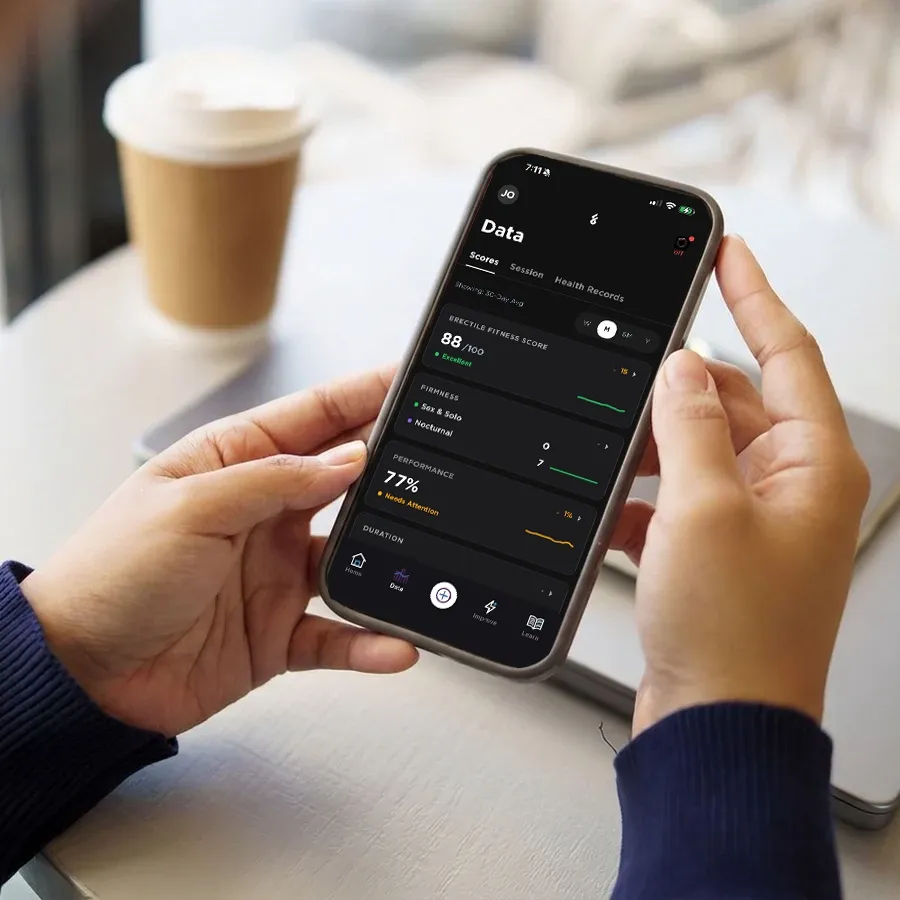
The TechRing app open on a phone, showing nightly erection data
  1. 01

    Run the panel any time

    FirmTech Labs is open to anyone, ring or no ring, and the complimentary coaching call comes with it.

  2. 02

    Own the TechRing to be coached

    Wear it, let a few weeks of nights accumulate, and monthly coaching opens up.

  3. 03

    Your data follows you

    Every call reads the newest nights against the oldest ones, so progress is measured rather than remembered.

Your action plan

You leave with a plan,
not a printout.

The most common thing men tell us is that someone once ran their labs and did not explain the results. Nobody asked what changed or wrote anything down.

Your coach does the part that usually gets skipped. He explains what your results cover and what yours look like, he reads them next to your TechRing data, and he hands you an order of operations you can start on this week. Coaching is education and coaching, not medical care, and it does not replace your doctor. Where you need one, your coach tells you so.

The usual visit compared with the FirmTech Protocol
The usual visitFirmTech Protocol
15 minutes or less, most of it history60 minutes, dedicated, one to one
Testosterone never measured, or measured aloneA panel built for men's health, hormones included
"Your labs are normal"What each part of the panel covers, and what yours shows
No data from your life outside the roomEvery night the ring has recorded
A prescription, or nothingA written protocol, and a referral if you need one

Why this coaching is different

The coach is reading a device with a research record behind it.

250,000+
Erections documented by the TechRing.
Peer-reviewed
The TechRing's data appears in published sexual medicine research.
MD, FACEP
Supervised by Elliot Justin, MD, emergency physician, founder and CEO of FirmTech.
Award-winning
Recognized at CES Showstoppers and SilverEco for innovation in health and wellbeing.

Built on research and science, not on opinion and hope. That has been FirmTech's mission since the first ring shipped, and it is the reason a FirmTech panel comes with a person rather than a PDF.

Monthly health coaching

One call a month,
with the same coach, every month.

Your first call gives you a plan. What one call cannot give you is a second look at whether that plan worked. Sleep moves over weeks. Habits move over months. Your data only tells a story once there is enough of it to compare, which is why coaching is a program rather than a purchase.

  • Sixty minutes, one to one, with a FirmTech coach who already knows your file.
  • Your TechRing trend read against last month, so you find out whether the plan moved anything.
  • Any new labs you upload, including the panel you already ran with us.
  • A written plan after every call: what to do, what to track, and what you are comparing next month.

Choose your start

Two ways in.

Labs is open to anyone and does not rebill. Monthly coaching is exclusive to owners of the TechRing and does not require labs.

FirmTech Labs

$425

One-time purchase · Open to anyone. Does not rebill.

  • Eighteen biomarkers across hormones, cardiovascular, kidney and liver function
  • Collected at home, no clinic and no waiting room
  • Complimentary coaching call to go through your results

Health Coaching TechRing owners

$165 / month

One 60-minute call. Cancel any time. Exclusive to owners of the TechRing. Does not require labs.

  • Sixty minutes, one to one, with the same coach every month
  • Your TechRing trend read against last month
  • A written plan after every call

No TechRing yet? Shop the TechRing

Buy both together and your first month of coaching is free.

What's in the panel

Eighteen biomarkers,
and why each one matters.

Hormones, cardiovascular and lipid markers, kidney function and liver function. Open any marker to see why it is on the panel.

The hormone panel

7 markers.

Total testosteroneEvery molecule of testosterone in circulation, bound and unbound together.

Why it matters.

Testosterone builds and maintains the male body. It governs muscle mass and bone density, red blood cell production, and where you store fat. It drives libido, erectile function, motivation, mood, and how well you sleep. When a man says he feels flat, soft, tired, and slower than he used to be, he is describing a cluster of things this one hormone touches.

Levels fall by roughly one percent a year from the thirties onward. The decline is slow enough that most men credit it to age, to work, or to stress, and never think to check.

Free testosterone (calculated)The fraction not bound to a carrier protein, and therefore available to your tissue right now.

Why it matters.

Only a small fraction of your testosterone is free to act. The rest travels bound to carrier proteins, which keeps it stable in the bloodstream but unavailable to the muscle, bone, brain, and vascular tissue that respond to it. Free testosterone is the portion your body can use today. Because of that, free testosterone often tracks symptoms more closely than total does. A man with a mid-range total and a low free result is a common presentation in men's health, and one a total-only panel misses entirely.

SHBG (sex hormone binding globulin)The protein that binds testosterone in your bloodstream and carries it in a form your tissue cannot use.

Why it matters.

SHBG is the protein that determines how much of your testosterone stays in reserve. It binds tightly, and testosterone bound to SHBG cannot act on tissue. A man with high SHBG can post a healthy total while relatively little of it is available to him. A man with low SHBG can post a modest total and have more in circulation than the number suggests.

SHBG also moves for reasons worth knowing. It rises with age and with thyroid activity, and it falls with insulin resistance, excess weight, and higher androgen levels.

DHEA-SAn androgen produced by your adrenal glands, which your body converts downstream into testosterone and estrogen.

Why it matters.

Your testes are not your only source of androgens. DHEA-S reports what your adrenal glands contribute, which gives a second and independent view of production. It peaks in a man's twenties and falls steadily from there, more predictably than testosterone does. Read beside your testosterone result, DHEA-S shows whether a low figure reflects one system or two, and that distinction changes what your coach recommends.

Estradiol (E2)The primary estrogen, made in men by converting testosterone through an enzyme called aromatase.

Why it matters.

Men need estrogen. Estrogen is not only a female hormone. Men convert a portion of their testosterone into estradiol through an enzyme called aromatase, and men need the result. Estradiol supports bone density, libido, erectile function, and mood. Men whose estradiol runs too low often report joint discomfort, flat libido, and low mood, which are the same complaints they may have blamed on testosterone.

LH (luteinizing hormone)The signal your pituitary gland sends to your testes, instructing them to produce testosterone.

Why it matters.

LH is the most interpretively useful marker on this panel, because it shows where in the chain a low result begins. Low testosterone with high LH means the signal is being sent loudly and the testes are not answering. Low testosterone with low or normal LH means the signal itself is quiet. Those are two different situations with two different sets of next steps, and a testosterone figure alone cannot tell them apart.

FSH (follicle stimulating hormone)The second pituitary signal to your testes, governing sperm production rather than testosterone production.

Why it matters.

FSH and LH leave the same gland and travel the same path, so reading them together shows whether pituitary signaling is intact across the board or disturbed selectively. FSH also carries direct relevance for any man weighing fertility, now or later.

The cardiovascular panel

Six markers, because an erection is a vascular event.

An erection is blood flow. The arteries that supply the penis are narrower than the arteries that supply the heart, and narrow vessels show trouble first. This is why FirmTech treats erectile fitness as a vital sign rather than a bedroom problem, and it is why a third of this panel measures what your blood is carrying.

Total cholesterolAll the cholesterol carried in your blood, summed across every particle type.

Why it matters.

Total cholesterol is broad and blunt, and on its own it says little. A good figure can hide a poor distribution; a high one can reflect a large and protective HDL fraction. It earns its place as context for the five markers around it rather than as a verdict of its own. Read it last, not first.

HDL cholesterolCholesterol carried in high-density particles, which move it away from your artery walls and back toward your liver.

Why it matters.

Total cholesterol sums the cholesterol carried across every particle in your blood, and that summing is both its use and its limitation. It gives one figure for how much cholesterol is in circulation. HDL is the traffic running in the useful direction. Higher figures are generally read as favorable, and HDL responds to the things a coaching program can actually change: regular training, alcohol intake, and body composition. It is among the more responsive markers here, which makes it a practical one to retest against.

LDL cholesterol (calculated)Cholesterol carried in low-density particles, the ones that deposit into your artery walls.

Why it matters.

LDL is the number most men have been told to watch, and it deserves the attention it gets. LDL particles carry cholesterol out to your tissue, and they are the particles that deposit cholesterol into artery walls when they linger in circulation. That deposition, accumulated over decades, is what narrows arteries, including the smaller arteries involved in erectile function. LDL as reported here is calculated, and it estimates how much cholesterol those particles carry rather than how many particles are present.

TriglyceridesFat circulating in your bloodstream, drawn from what you have eaten and what your liver has made.

Why it matters.

Triglycerides move fast and respond hard. Diet, alcohol, and insulin resistance all push them, and few markers here react as quickly to a change in habits, which makes them a strong short-term signal that a plan is working. High triglycerides paired with low HDL is a recognized metabolic pattern, and your coach will look for it specifically, since this panel carries no dedicated blood sugar marker.

ApoB (apolipoprotein B)The number of artery-damaging particles in your blood. Each one carries exactly one ApoB molecule, so counting ApoB counts particles.

Why it matters.

Every particle capable of depositing cholesterol into an artery wall carries exactly one ApoB molecule. Measuring ApoB therefore counts those particles directly, rather than estimating how much cholesterol they hold.

That distinction has consequences. Particle count predicts cardiovascular risk more reliably than LDL cholesterol does, and the two can disagree: a man with many small, cholesterol-poor particles can post a reassuring LDL while carrying elevated risk. Specialists have moved toward ApoB for this reason, and it remains uncommon on a standard annual physical.

Lp(a), lipoprotein(a)A specific lipoprotein whose level is set almost entirely by your genetics.

Why it matters.

Lp(a) finds the man who has done everything right. Diet moves it very little. Training moves it very little. A man can post an immaculate lipid panel and still carry an elevated Lp(a) inherited from a parent, and he will never know unless somebody measures it, which most panels never do. Because the value is largely fixed at birth, a single measurement usually answers the question for life. Knowing it changes how aggressively the rest of this panel is worth managing.

The kidney panel

Three markers, because filtration underwrites everything else.

Your kidneys regulate blood pressure, balance fluid, and clear nearly everything you put into your body. Filtration also determines how you handle medications and supplements, which matters the moment a plan involves either one.

This panel measures filtration two ways, on purpose.

CreatinineA waste product of ordinary muscle metabolism, cleared from your blood by your kidneys.

Why it matters.

Creatinine is a waste product your muscles generate continuously and your kidneys clear from the blood. When filtration slows, creatinine accumulates, which makes it a long-standing measure of kidney function. Kidney function matters on this panel for two reasons: it regulates blood pressure, which bears directly on vascular health, and it determines how your body clears medications and supplements.

Creatinine has one well-documented limitation. Because it originates in muscle, a man with high muscle mass produces more of it, and his result can read as elevated while his kidneys function normally. That limitation is why this panel includes a second, independent measure.

Cystatin CA protein produced at a steady rate by essentially every cell in your body, and cleared by your kidneys.

Why it matters.

Cystatin C is produced at a constant rate by nearly every nucleated cell in your body and cleared almost entirely by your kidneys. Production does not vary with muscle mass, diet, or training, so it avoids the confounding that affects creatinine.

For a man who lifts or carries above-average muscle, cystatin C is generally the more accurate estimate of filtration. Measuring both is what makes the result trustworthy: agreement between them confirms the reading, and disagreement usually points to muscle mass rather than to a kidney problem.

eGFR (cystatin-based)Your estimated glomerular filtration rate, calculated from your cystatin C. It reports how much blood your kidneys clear per minute.

Why it matters.

eGFR turns a protein value into a rate, which turns an abstraction into something you can hold onto and track. Basing it on cystatin C rather than creatinine keeps muscle mass out of the calculation entirely. This is the single number to watch across retests, and a steady eGFR over years is worth more than any one reading.

The liver panel

Two markers, because your liver sets the terms.

Your liver processes your hormones, your medications, your supplements, and your alcohol. It also manufactures the carrier proteins that decide how much of your testosterone you can use. Liver health is not a footnote on a men's health panel. It sits upstream of your hormone results.

AlbuminThe most abundant protein in your blood, manufactured by your liver.

Why it matters.

Albumin does double duty here. It reflects how well your liver builds protein and how well you are nourished, and it binds testosterone loosely, unlike SHBG, so albumin-bound testosterone stays partly available to your tissue. That loose binding is why albumin feeds directly into your free testosterone calculation. A marker filed under liver function is quietly shaping your hormone result.

ALT (alanine aminotransferase)An enzyme concentrated in liver cells, which leaks into the blood when those cells come under stress.

Why it matters.

ALT responds to alcohol, to prescription medications, and to supplements, including several marketed specifically to men for training and performance. It also tends to rise with fat accumulation in the liver, a condition tied closely to insulin resistance, and insulin resistance is among the most common upstream drivers of low testosterone. On a panel carrying no dedicated blood sugar marker, ALT is the closest indirect window into that picture.

Collected at home · No clinic visit · Complimentary coaching call included

Your cart

    Unlock 15% off

    What’s your main goal?

    We’ll match you to the right ring.